Fluid-structure interaction
Fast nonlinear models for sails (vortex lattice, extended lifting line, semi-rigid sails and forestay) and for composite hydrofoils.
Associate Professor · Arts et Métiers Institute of Technology, École Navale, IRENav, France
I develop numerical and experimental methods for the design of lifting marine systems. My work combines fast flow models, fluid-structure interaction, experiments, and gradient-based or surrogate-based optimization.
Fast nonlinear models for sails (vortex lattice, extended lifting line, semi-rigid sails and forestay) and for composite hydrofoils.
Efficient global optimization (EGO) with Gaussian processes, multi-fidelity, constraints and non-computable domains; adjoint gradients by algorithmic differentiation.
Panel methods (PUFFIn), free-surface effects, partial cavitation, robust section design.
Simultaneous design and routing of wind-assisted ships, representative weather conditions, collision risk.
Experimental and multi-fidelity optimization of cycloidal propeller pitch laws; oscillating foils near the free surface.
Noise radiated by lifting bodies and marine propulsors: Ffowcs Williams–Hawkings acoustic analogy coupled with unsteady panel or CFD flow solvers.
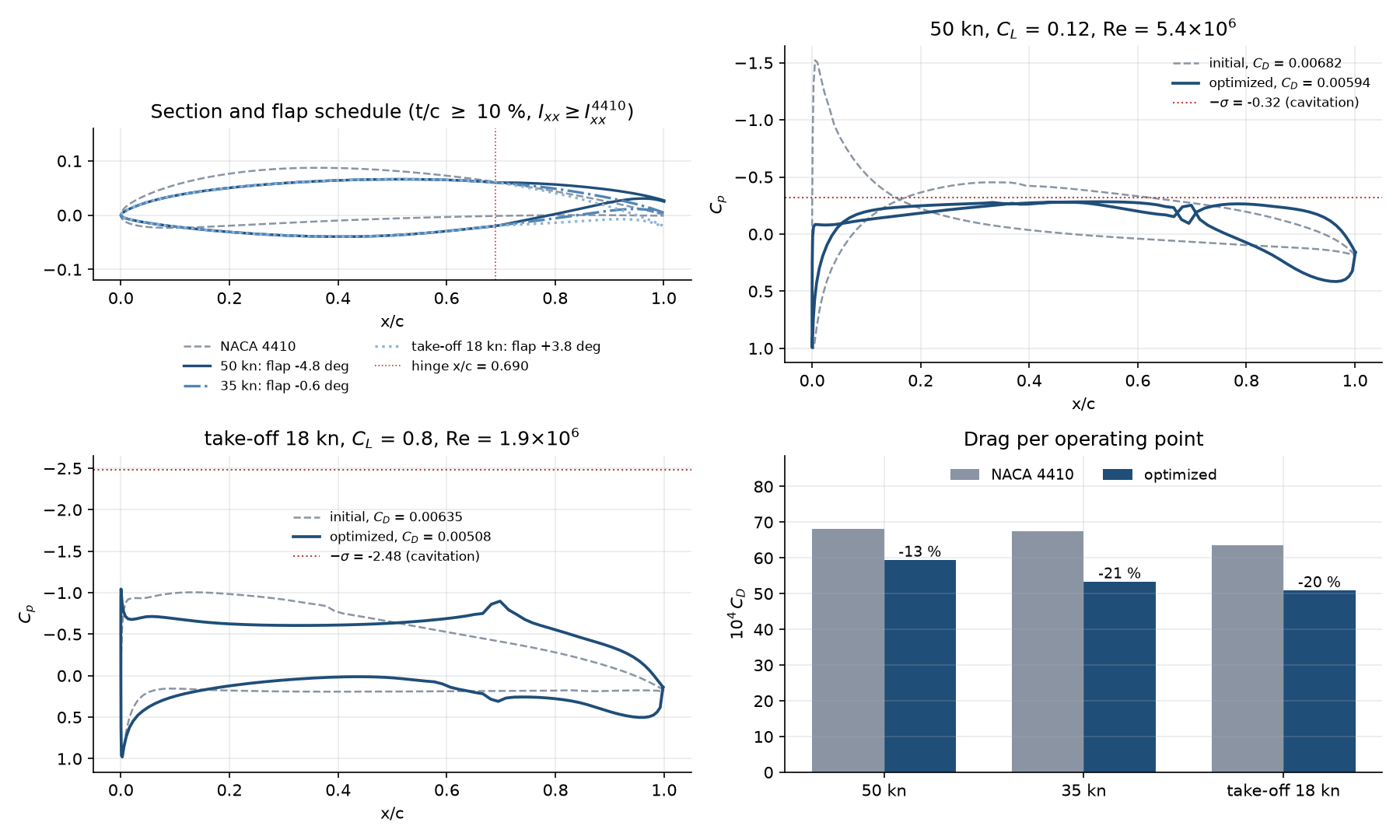
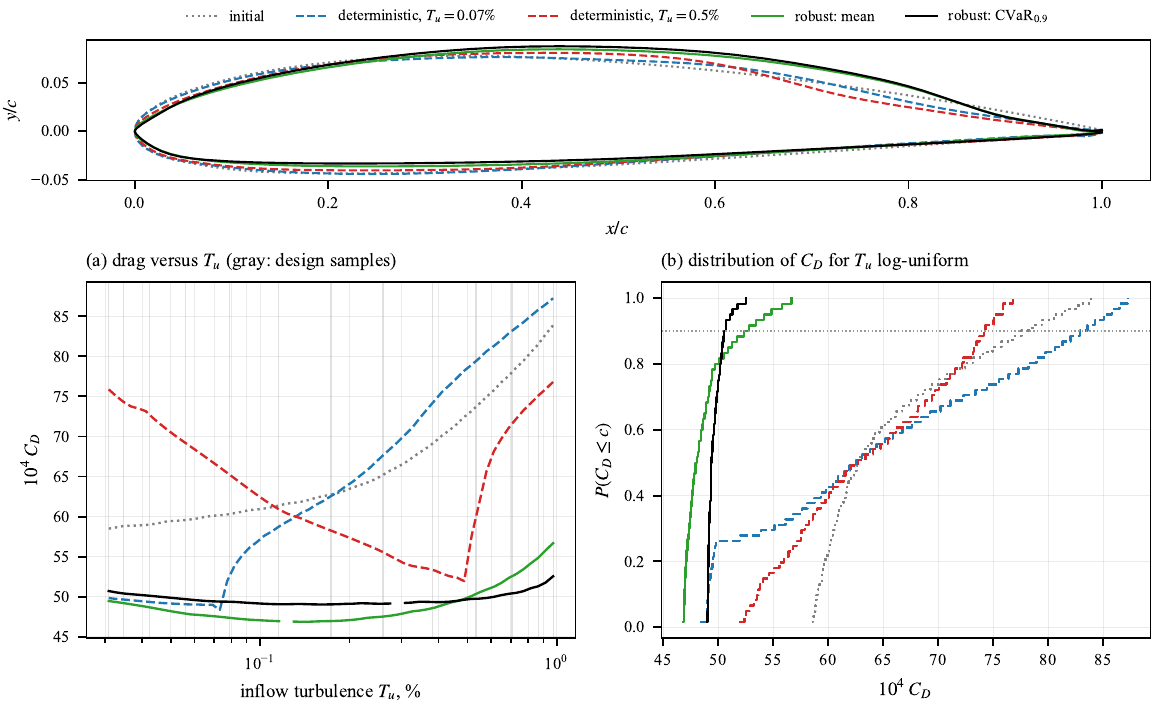
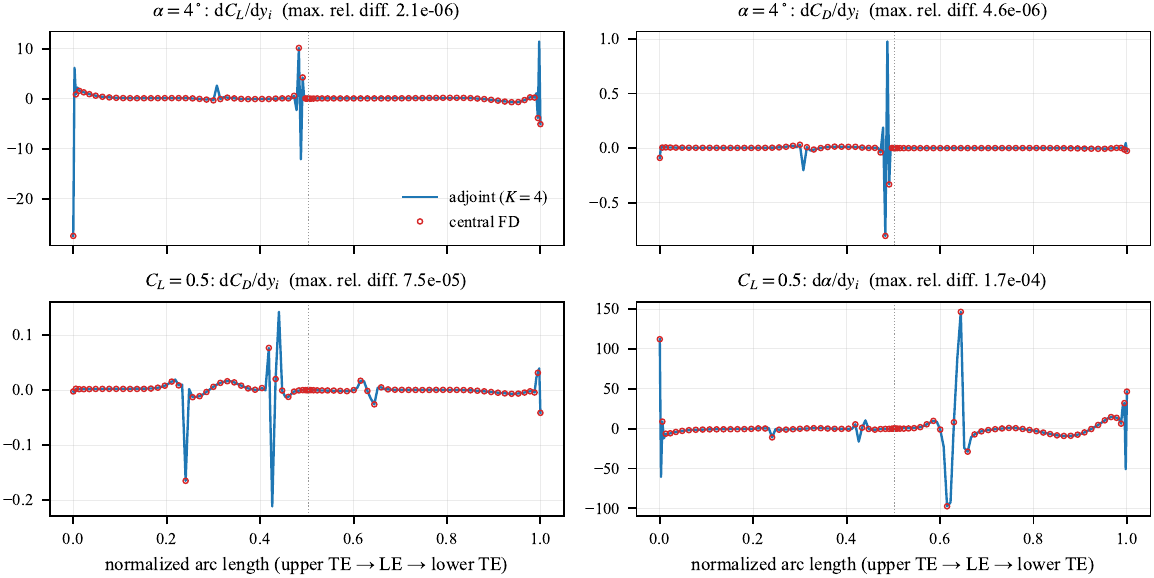
Gradient-based optimization of foil, wing and blade sections. The complete XFOIL solver, eN transition included, is differentiated in reverse mode with Tapenade: one gradient costs about one analysis plus one adjoint sweep, whatever the number of shape variables. Partial cavitation, robust design under uncertain turbulence and incidence, trailing-edge flap.
Potential Unsteady code for Foils with Free surface INcluded: a three-dimensional unsteady boundary element (panel) method for lifting bodies such as hydrofoils, wings, rudders, stabilisers and fins. Bodies in an infinite fluid, near a wall or a free surface, fixed or with imposed motions, in regular or irregular waves; free wake, linearised free surface, viscous boundary layer with transition, sheet cavitation, dynamic positioning and hydroacoustics (Ffowcs Williams–Hawkings). A few seconds to a few minutes per computation on a laptop.
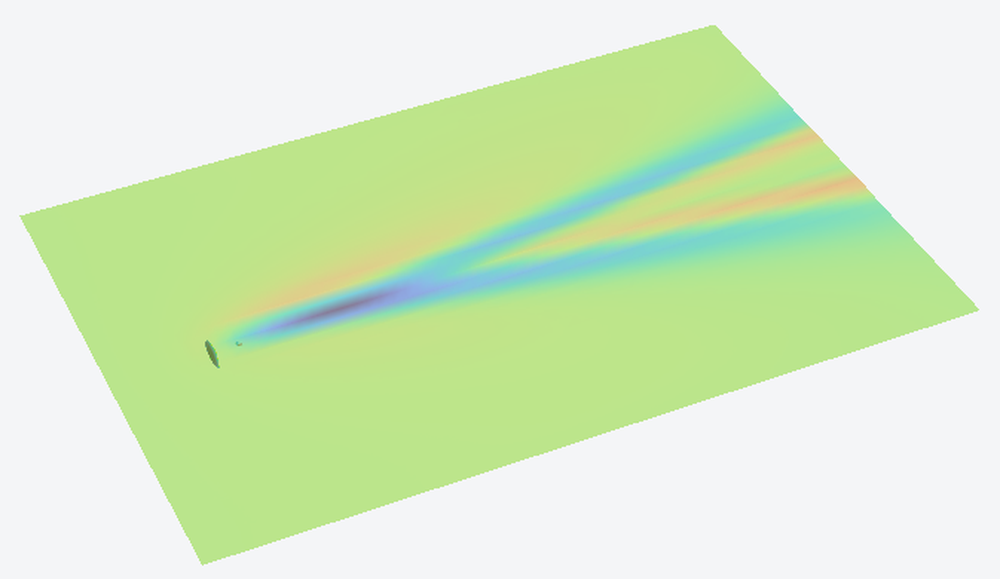
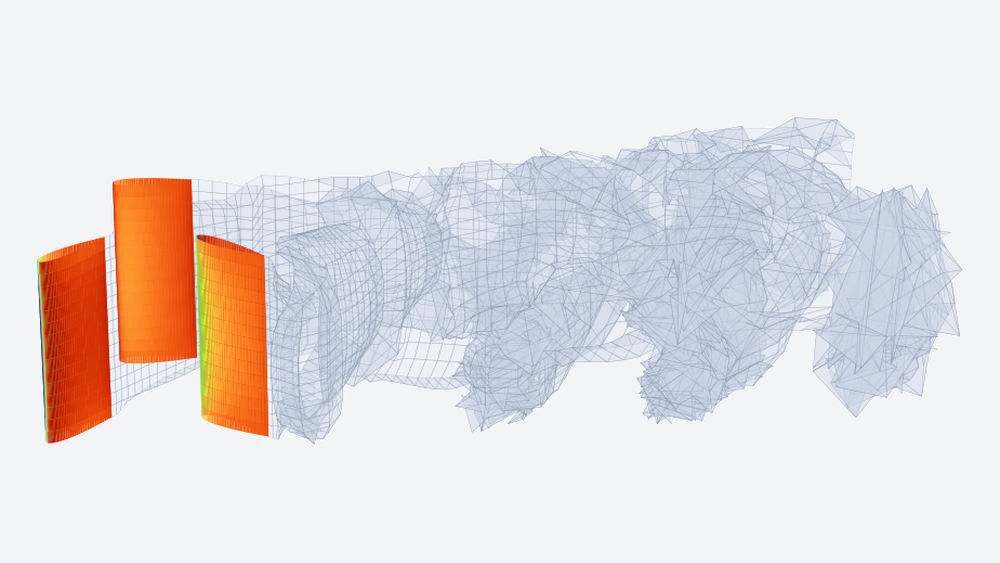
Developed with contributions from École Navale, ENSTA and Ifremer. Distributed as a ready-to-run Windows package with its user guide (no installation needed).
Loading…
Arts et Métiers Institute of Technology, École Navale, IRENav, France